




 Share
Share
05 May 2026
As the UK accelerates toward net zero, the built environment is seeing a rapid evolution of standards, frameworks and certifications. The recent introduction of the UK Net Zero Carbon Buildings Standard (UKNZCBS) adds another important layer, but also raises a common question:
How does it relate to existing frameworks like ISO 14001, ISO 50001 and NABERS UK?
The answer is that these frameworks are not alternatives. They are complementary tools, each addressing a different aspect of sustainability. Understanding how they fit together is key to delivering credible, measurable net zero outcomes.
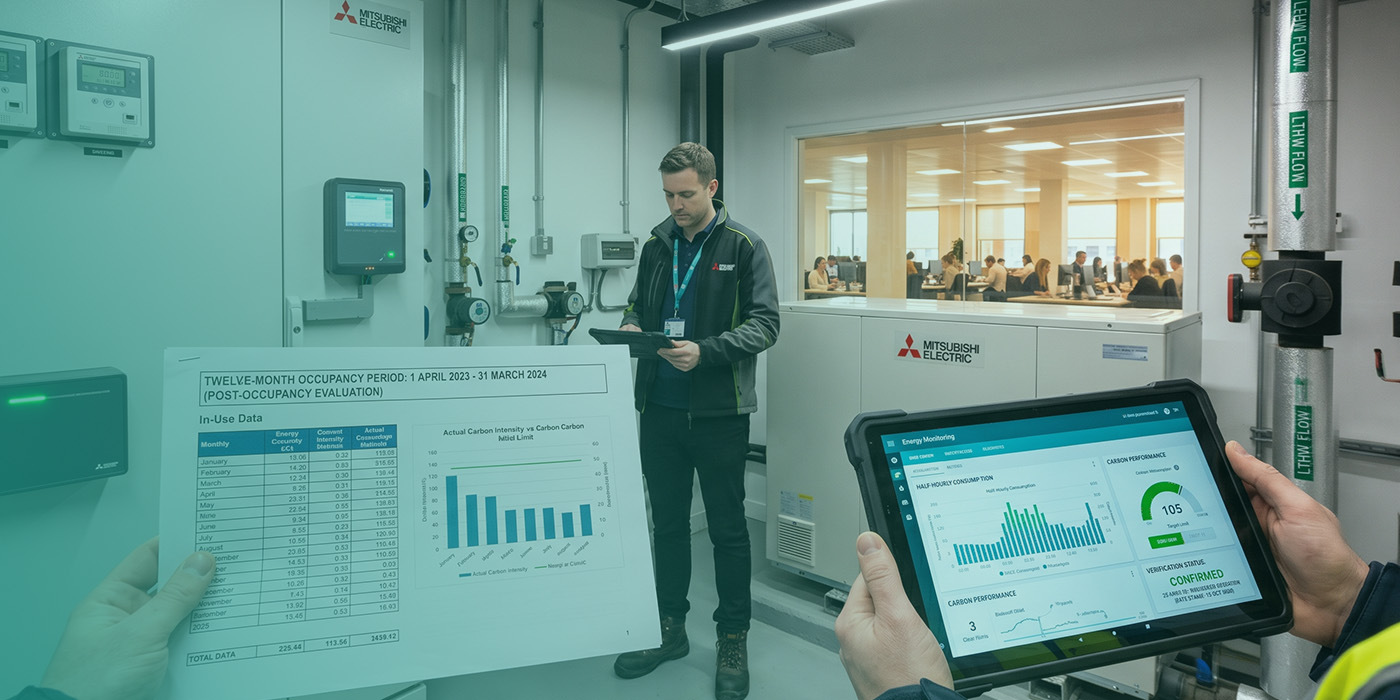
Operational carbon performance evidenced at the point of generation: post-occupancy evaluation data, live half-hourly consumption monitoring and a confirmed verification status together demonstrate what the UK Net Zero Carbon Buildings Standard means in practice at building systems level.
The Role of the UK Net Zero Carbon Buildings Standard
The UK Net Zero Carbon Buildings Standard is designed to provide a clear, unified definition of a net zero carbon aligned building.
It focuses on measured, in-use performance, operational energy and carbon limits, embodied carbon considerations, and verification based on real data (not design intent).
One of the most significant features is the emphasis on verified performance. Claims of net zero alignment can only be made after a building has been occupied and measured in use for at least twelve months. This moves beyond design-stage predictions to actual operational outcomes.
The standard is voluntary, but its evidence-based approach and cross-industry backing suggest it will become increasingly influential.
In essence, it answers the question: Has this building actually achieved net zero in practice?
This makes it a performance-based verification standard at the building level.

An ISO 14001 internal audit review in session, with the full suite of required documentation laid out across the table and a senior environmental manager leading the team through findings, compliance status and objectives progress for the twelve-month review period.
ISO 14001: Managing Environmental Impact
ISO 14001 operates at an organisational level, providing a framework for an Environmental Management System (EMS).
It helps organisations identify environmental impacts, set objectives and targets, ensure legal compliance, and drive continual improvement.
However, ISO 14001 does not define specific carbon or energy targets, certify buildings as net zero, or measure actual building performance.
Instead, it ensures that an organisation has the processes and governance in place to manage environmental performance effectively.
For property organisations, ISO 14001 demonstrates structured commitment to environmental management. It supports good governance and provides a framework for improvement. But it does not, by itself, verify that individual buildings achieve specific sustainability outcomes.

ISO 50001 in operation across a multi-site portfolio: consumption tracked against baselines at every location, twelve-month carbon intensity trends measured against target, and the mechanical plant whose performance underpins it all visible through the glazed partition behind.
ISO 50001: Driving Energy Performance
ISO 50001 builds on this by focusing specifically on energy management.
It provides a structured framework to monitor and analyse energy use, establish energy baselines, improve energy performance over time, and embed energy efficiency into operational decision-making.
Compared to ISO 14001, ISO 50001 is more data-driven, more energy-focused, and more directly aligned to carbon reduction outcomes.
The standard helps organisations take control of their energy consumption, reduce costs, and build resilience against energy price volatility. It also supports qualification for ESOS audit exemption where the certified system covers at least 90% of total energy use.
But like ISO 14001, ISO 50001 does not define what “net zero” looks like. It supports the journey rather than verifying the destination.

NABERS UK measurement begins at the meter: a building performance professional capturing the sub-metered consumption data that feeds directly into the operational energy rating that tenants, investors and the Standard itself now demand to see evidenced.
NABERS UK: Measuring Real Performance
NABERS UK brings the focus back to the building itself, measuring actual operational energy performance using verified data over a 12-month period.
It provides a simple star rating system, benchmarking against similar buildings, and transparency on real-world efficiency.
This makes NABERS UK a powerful tool for understanding how buildings perform in use, identifying performance gaps, and driving operational improvements.
In many cases, NABERS UK acts as a practical stepping stone toward achieving UKNZCBS targets, particularly for operational energy.

The key differences between ISO 14001, ISO 50001, NABERS UK and the Net Zero Carbon Buildings Standard become clearer when they are mapped as a sequential, interconnected pathway from environmental governance through to verified net zero performance.
Key Differences at a Glance
Each framework answers a different question:
UK Net Zero Carbon Buildings Standard: Is the building net zero?
NABERS UK: How well does the building actually perform?
ISO 50001: How effectively are we managing energy?
ISO 14001: How well are we managing environmental impacts overall?
How They Work Together
Rather than choosing one approach, leading organisations are combining these frameworks to create a joined-up strategy.
The first step is to start with management systems. ISO 14001 and ISO 50001 establish the structure and discipline needed to manage environmental and energy performance. They ensure clear accountability, data-driven decision-making, and continuous improvement.
The second step is to measure actual performance. NABERS UK provides verified, real-world performance data, showing how buildings are operating in practice. This helps organisations validate energy strategies, benchmark performance, and identify improvement opportunities.
The third step is to verify net zero outcomes. The UK Net Zero Carbon Buildings Standard uses measured data to determine whether a building meets defined net zero criteria. This moves beyond ambition and targets, providing credible verification, consistency across the industry, and confidence for investors and occupiers.

Sometimes the clearest way to understand how ISO 14001, ISO 50001, NABERS UK and the Net Zero Carbon Buildings Standard fit together is simply to lay everything out on the table and work through it with the right advisor.
A Simple Way to Think About It
These frameworks can be viewed as a layered system:
ISO 14001 sets the environmental management framework.
ISO 50001 drives energy performance improvement.
NABERS UK measures actual building performance.
UKNZCBS confirms whether net zero has been achieved.
Together, they create a clear pathway: Management leads to Measurement, which leads to Verification.
The Benefits for Landlords and Occupiers
Understanding how these frameworks work together is important, but the real question for most organisations is: What is the commercial value?
For landlords and property owners, the benefits include stronger asset value and future-proofing against regulatory tightening and stranding risk. Buildings with credible sustainability credentials lease faster, attract higher-quality tenants, and achieve stronger rental values. Alignment with recognised frameworks also supports better ESG reporting, access to green finance, and increased confidence from lenders and institutional investors.
Using ISO 50001 and NABERS UK to actively manage energy performance can reduce consumption, lower operating costs, and improve service charge transparency. The UK Net Zero Carbon Buildings Standard provides a clear, evidence-based definition of net zero, helping landlords avoid greenwashing risks and make defensible ESG claims.
For occupiers, the benefits include lower energy costs through buildings that are actively managed and benchmarked. Choosing buildings aligned with NABERS UK and UKNZCBS helps improve ESG disclosures, demonstrate progress toward corporate targets, and reduce reporting complexity. High-performing buildings often deliver more stable internal conditions and better building management. Occupiers also benefit from reduced regulatory and reputational risk by being in buildings that are compliant with current and future energy regulations.
Perhaps the most important shift is this: sustainability is no longer a “landlord issue” or an “occupier issue”. It is a shared responsibility. These frameworks encourage greater collaboration, data sharing between landlord and tenant, and joint approaches to energy reduction and net zero.

A building performance review that tells the right story: operational carbon confirmed, energy targets met, third-party verification complete and net zero alignment confirmed, with every document on the table to evidence it.
Why This Matters Now
As scrutiny around sustainability claims increases, the industry is shifting toward evidence-based performance.
Organisations can no longer rely on design-stage predictions or high-level commitments alone. They need to demonstrate real energy performance, measurable carbon reductions, and verified net zero outcomes.
Using these frameworks together enables a more robust and credible approach, one that stands up to investor, regulatory and market expectations.
Conclusion
The growing number of standards in the UK property sector can feel complex, but each plays a distinct and valuable role.
The UK Net Zero Carbon Buildings Standard does not replace ISO 14001, ISO 50001 or NABERS UK. It builds on them.
Those who understand how to integrate these frameworks will be best placed to deliver buildings that are not only designed for net zero, but proven to achieve it in reality.
📞 Talk to us about sustainability strategy: https://weareinteb.co.uk/contact

View

View

View

View

View

View

