




 Share
Share
03 Aug 2026
On a fixed contract, electricity has one price. On a dynamic, half hourly priced contract, it has forty eight prices a day, and they are nothing like each other. Commercial battery arbitrage is simply the business of buying at the cheap ones and using at the expensive ones.
Overnight, when demand collapses and the wind keeps blowing, the grid ends up with more power than anybody wants. Prices fall into single figures, and on a windy night they can go to nearly nothing. Then at teatime, when the country comes home and puts the kettle on, the same electricity, down the same wire, costs 30p a unit. On a cold winter evening it can pass 50p.
Same power. Same cable. Ten times the price, depending only on when you take it.
A battery is how you take it at the right time.
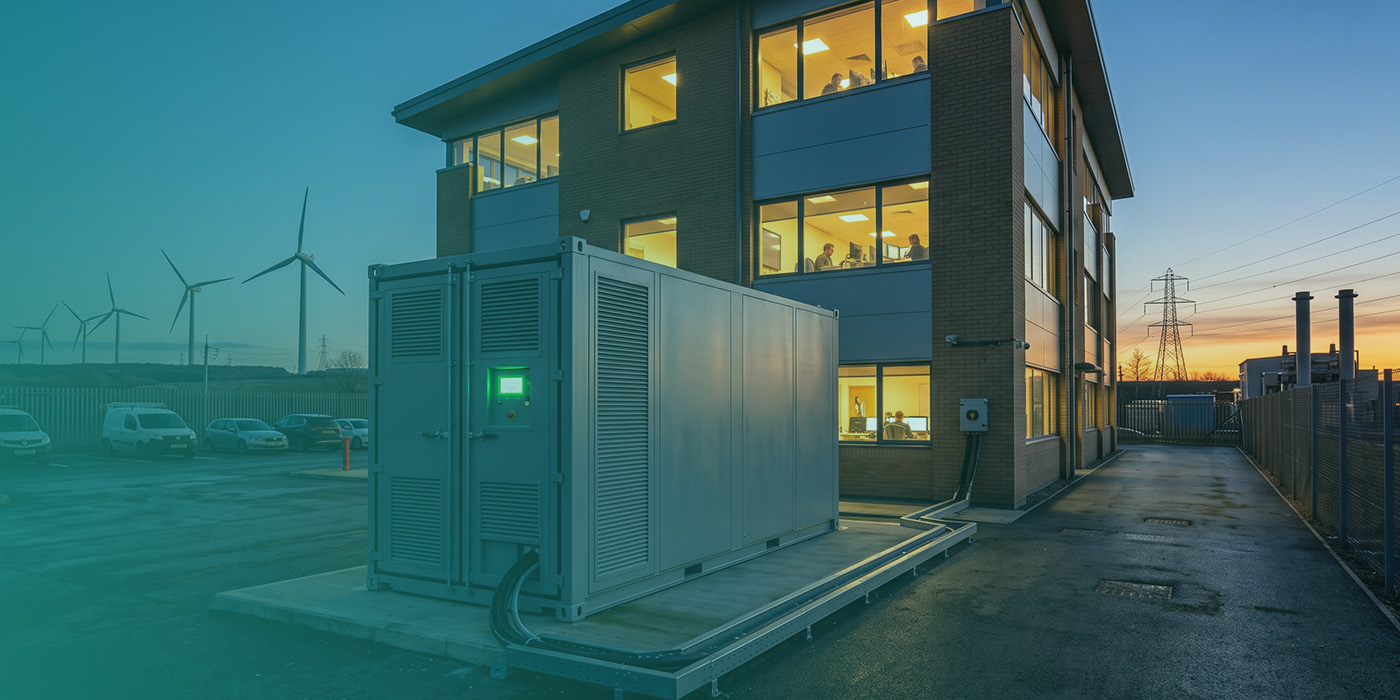
The trade in a single frame: wind generation and grid infrastructure on either side, a battery unit in the middle connecting them, and a building full of people drawing from stored energy rather than paying peak import rates.
The battery arbitrage trade
You charge overnight while power is nearly free. You run the building on the battery through the expensive part of the day. You are not generating anything and you are not doing anything clever with the technology. You are choosing when to buy.
Every finance director asks the same question next, and it is the right one. Is that not a bit cheeky, and how long before somebody closes it off?
It is not a loophole. It is a job nobody is doing
That teatime peak is met by gas, because you cannot choose to turn a wind turbine on. National Grid has spent decades planning for the moment a football match goes to half time and the nation reaches for the kettle. The evening peak is the most expensive and the dirtiest hour of the day.
So when you discharge a battery into that peak, you flatten it. Battery arbitrage pays because it does the job the system needs doing. You are paid because you are doing the thing the system needs doing. That is not a loophole. It is the mechanism.
If you want to know where this ends up, look at Australia. By the end of last year, batteries there were setting the evening peak price nearly 40 per cent of the time, against under 5 per cent a year earlier. Gas generation has fallen to its lowest quarterly average since 1999. The evening price spike that used to reach almost 500 Australian dollars a megawatt hour has been flattened to a ripple.
And look at where the money went. Battery arbitrage is now 97 per cent of Australian battery revenue. Frequency response, which was the clever, fashionable market, fell by 43 per cent, because it filled up. The exciting markets saturate. The boring one, buying low and using high, is structural, because it comes from the shape of the generation mix rather than from a subsidy.
You may not need solar at all
I will admit this part surprised me.
The usual pitch is panels on the roof. Generate your own power, use your own power. That is a generation mindset and it is not wrong. But the grid is already producing enormous quantities of cheap, clean electricity at times when almost nobody can use it. You do not have to build a power station. There is one, and it is running.
Solar makes a battery better, because it charges it for free in the middle of the day. But solar is not the prerequisite. The battery is. I was about to put panels on my own house and I have stopped to ask myself whether I need them, or whether what I actually need is somewhere to put cheap power at three in the morning.

Before the battery charges its first cycle, someone has to do this: pull the half-hourly consumption data, map it against the price curve, size the battery to the load profile and work out whether the numbers actually stack up. That analysis is what makes the difference between a system that earns its return and one that does not.
What battery arbitrage needs before any of it works
Battery arbitrage needs a half hourly meter. Without one you cannot see the price, so you cannot act on it. That single fact gates the entire opportunity, and a great many estates are still sitting behind it.
It needs the right contract, and you have to ask for it. A broker sent out to find the cheapest headline rate will come back with exactly that. A dynamic, half hourly priced contract does not arrive by accident.
And the battery has to be sized from your actual consumption shape, not an annual total. Generic payback figures are close to useless for a commercial site, because the return is set by the shape of your day, not the volume of your year.
Two things I would rather you heard from us
A battery does not automatically give you backup power. People assume it behaves like an uninterruptible power supply. It does not. The ability to run islanded from the grid has to be specified and designed in from the beginning, and it costs more. If resilience is a reason you are buying, say so on day one, because it is very expensive to add later.
And the value usually sits in not buying at peak, rather than in selling at peak. Exporting earns you the export rate. Not importing saves you the full retail rate, with the network charges and levies on top. For most commercial sites the second number is the bigger one. The spread is real, but it tends to arrive as a smaller bill rather than as a cheque.
Why almost nobody is doing battery arbitrage
This play needs a procurement brain and a carbon brain at the same time, with somebody who understands the metering sitting underneath both. In most businesses those are different departments, so the opportunity falls neatly into the gap between them. Procurement is measured on unit rate. Sustainability is measured in tonnes. Nobody at all is measured on the spread.
That gap is not unique to batteries. If you buy energy but do not measure carbon, your largest customer is going to ask for your footprint, and it will probably arrive inside a tender. If we already run your procurement and validate your invoices, that is not a project. It is another report, run on data we already hold and have already checked. You want to be the supplier who says “you mean this report”, because at that moment you stop being a risk to their net zero plan, and that is worth more than a discount.
If you measure carbon but do not manage procurement, you are working from estimated bills and meter readings that somebody handed you. Your carbon number is only ever as good as your consumption data, and you have no way of knowing how good that is.
The quick win, and the catch in it
Ask for both prices at tender. The renewable contract and the standard one, side by side, at the same time. The premium is often small, and a renewable contract can take your market based Scope 2 to zero.
Be careful how you say that, though. The GHG Protocol requires dual reporting, so your location based figure still appears and does not move. And the Protocol is consulting on requiring hourly matching, which would mean an annual certificate no longer carries the claim on its own.
Which takes you straight back to the battery. A green tariff is an accounting claim you make once a year. A battery charged on overnight wind is a physical one, made forty eight times a day. The rules are moving in one direction, and it is not towards the certificate.
The grid does not know or care which department you sit in.
FAQ
What is commercial battery arbitrage?
Battery arbitrage means charging a battery when electricity is cheap and using or exporting that stored power when electricity is expensive. On a dynamic, half hourly priced contract, overnight prices can fall into single figures per kWh while the evening peak can reach 30p or more. A battery lets a business capture that spread without generating any power itself.
Do I need solar panels to make a battery worthwhile?
No. Solar improves the return, because it charges the battery for free during the day, but grid only arbitrage works on its own. The national grid already produces large quantities of cheap electricity overnight when demand is low and the wind is blowing. The battery is the essential component. Solar is an enhancement.
Will battery arbitrage stop working once everyone does it?
It is unlikely to disappear, because the spread comes from the shape of the generation mix rather than from a subsidy. The evening peak is met by gas, which is expensive and dispatchable, while overnight wind is cheap and cannot be turned off. In Australia, batteries now set the evening peak price around 40 per cent of the time and energy arbitrage accounts for 97 per cent of battery revenue. The frequency response market, by contrast, has saturated and revenues there have fallen sharply.
Does a battery keep my building running during a power cut?
Not automatically, and this is a common and expensive misunderstanding. A standard commercial battery is not an uninterruptible power supply. The ability to run islanded from the grid must be specified and designed in from the start, and it adds cost. If resilience is part of your reason for investing, raise it at the outset rather than after installation.
Do I need a half hourly meter for battery arbitrage?
Yes. Without half hourly metering you cannot see when electricity is cheap or expensive, so you have no price signal to act on. Half hourly data is also what allows a battery to be sized correctly against the actual shape of your demand. An annual consumption total is not sufficient.
Can a renewable energy contract really take my Scope 2 emissions to zero?
It can take your market based Scope 2 figure to zero, provided the contract meets the GHG Protocol Scope 2 Quality Criteria. It does not remove your reporting obligation. The GHG Protocol requires dual reporting, so you must also disclose a location based figure calculated on the grid average, and that number does not change. The Protocol is currently consulting on requiring hourly matching, which would tighten what an annual certificate can support.
Should procurement or sustainability own battery storage?
Both, which is why it is so often owned by neither. The business case needs a procurement view of the contract, a sustainability view of the carbon outcome, and a technical view of the metering. Procurement is typically measured on unit rate and sustainability in tonnes, so the value in the spread between prices sits outside both sets of objectives.

View
View

View

View
View

View

