



 Share
Share
13 Jul 2026
The commercial property market continues to evolve. As demand for traditional retail and some office space has softened, investors and landlords have increasingly turned their attention towards industrial estates, trade counters, open storage facilities and legacy manufacturing sites. These assets often offer attractive yields, strong occupier demand and opportunities for repositioning or redevelopment. However, they can also inherit decades of utility infrastructure decisions that were never designed for today’s ownership models, tenant requirements or asset strategies.
When acquiring or managing these types of assets, due diligence often focuses on leases, condition surveys, environmental liabilities and rental income. Utilities can receive far less attention, despite having the potential to create significant operational, financial and leasing risks. One of the most common issues is a single landlord electricity supply feeding multiple occupiers. On the day of acquisition this rarely appears problematic. The units have power, tenants are trading and rents are being collected. The risk sits beneath the surface, in how energy is measured, recovered and managed. Without a clear metering and recovery strategy, landlords can inherit ongoing administrative burdens, unrecoverable costs, tenant disputes and future barriers to leasing, redevelopment or disposal. What appears to be a simple utility arrangement can quickly become a significant asset management challenge.
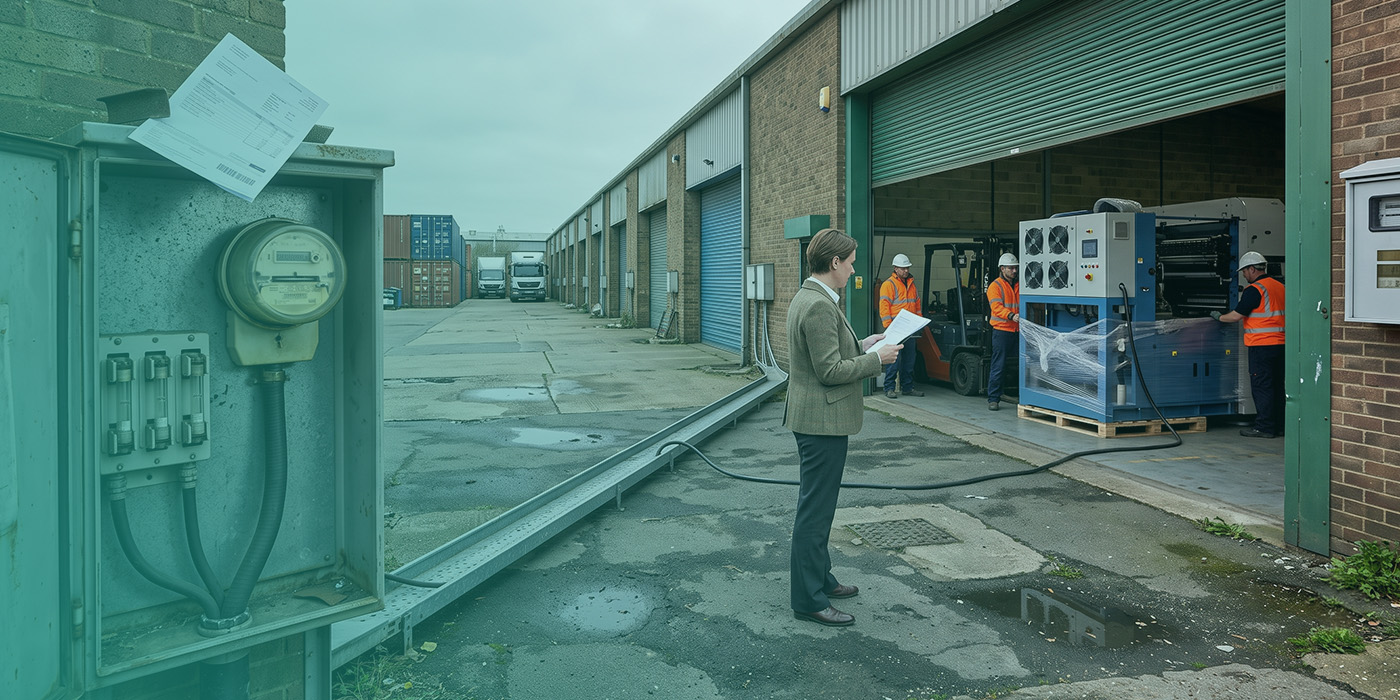
A single meter, a power cable running across the yard, and a piece of industrial machinery being installed in a unit that has just taken on a new occupier with significantly higher load requirements. This is the single supply problem made visible.
The single supply problem
Where a site has a single incoming supply behind one MPAN, the supplier bills the landlord for everything that passes through it. The occupiers behind that supply are not known to the supplier. Whatever they use, the landlord pays for, and then has to recover it from the occupiers itself. Without properly split utilities, that recovery rests entirely on the landlord’s own metering and administration.
That arrangement can limp along while occupiers are stable and consumption is predictable. It stops working the moment something changes. An occupier introduces high consumption machinery, or a specialised process load, and suddenly the single supply is carrying demand it was never sized for, with the landlord absorbing the cost and the risk until the recharge catches up, if it ever fully does.
| One MPAN, several occupiers
The supplier bills the landlord for the whole supply. The occupiers behind it are invisible to the supplier. Recovery depends entirely on the landlord’s own sub-metering and recharging, and on it being accurate. |
The consequences
The risks fall into two groups, and one of them affects the value of the asset itself.
That last point is the one that tends to land with investors. A power constraint is not just an operational nuisance. It narrows the pool of future tenants, and that feeds directly into the value and the exit.

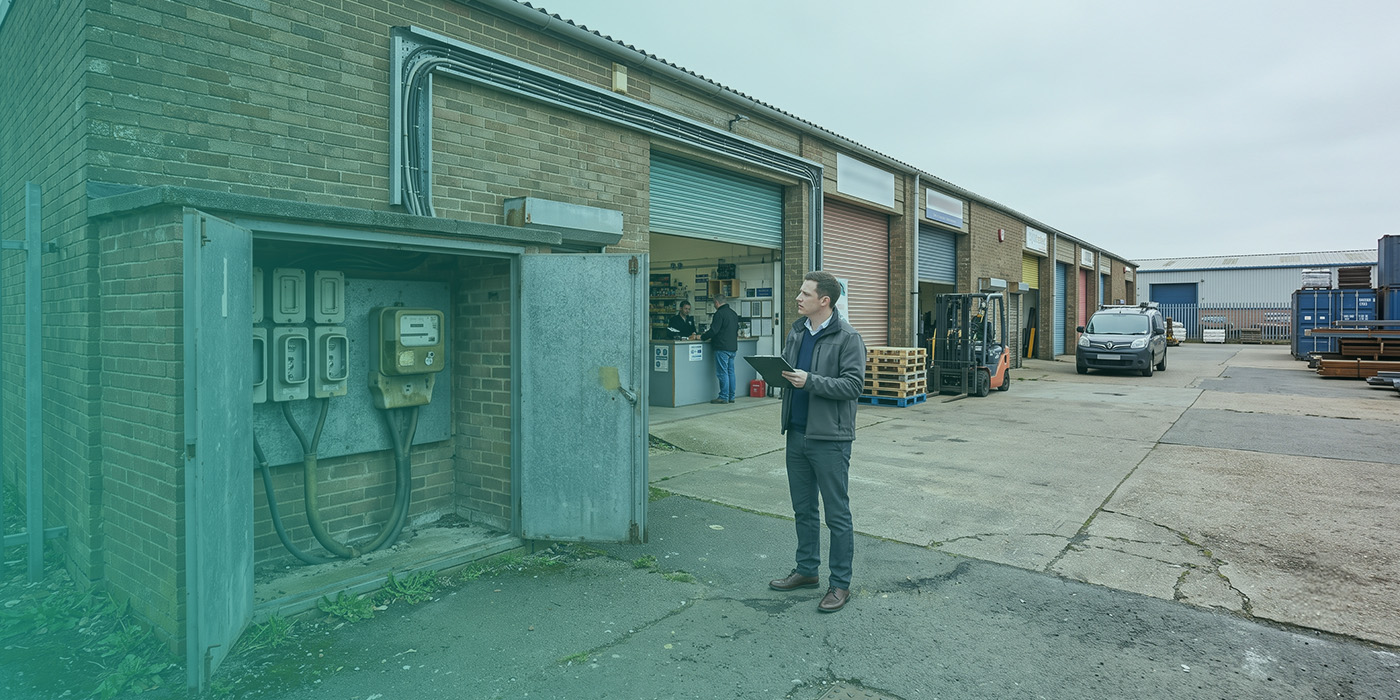
Two operatives, two different pieces of information: one reading what the supply is actually doing, the other mapping what the site drawing says it should be doing. The gap between those two things is where the work starts.
Two routes, depending on the site
There is no single answer, because sites differ. The right approach depends on the infrastructure, the occupier mix and the landlord’s appetite. Broadly there are two routes.
The judgement is which of these fits the site, and that judgement should be made from the infrastructure outward, not assumed. It starts with understanding what is actually coming into the site and how it is distributed.
Map the infrastructure first
Before deciding between a split and a sub-metering framework, the incoming infrastructure and the distribution routes have to be understood. What is the incoming capacity in kVA. Where does the supply enter, and how is it distributed to each occupier. Which occupiers sit behind which part of the network. Without that map, any recharging strategy is built on assumptions, and assumptions are what produce the disputes in the first place.
With the infrastructure mapped, a tenant metering strategy can be designed that fits the site rather than fought against it. That is the difference between a recharging arrangement that holds up and one that generates a query every quarter.

Standing in the yard with the site drawing is usually the moment it becomes clear that the arrangement made sense when the estate was built, and has been getting harder to justify ever since.
The arrangement that ages badly
This matters most at the point of acquisition or when an asset strategy changes, because that is when utility arrangements are inherited and when they are often cheapest and easiest to address. A single incoming supply serving multiple occupiers may function adequately for the existing use, but can quickly become a constraint when units are re-let, subdivided, merged, refurbished or repositioned for a different tenant profile. What appears to be a minor metering issue can ultimately impact leasing flexibility, service charge recovery, occupier satisfaction and future redevelopment plans.
Early due diligence allows landlords and investors to understand whether existing utility infrastructure aligns with their long-term objectives for the asset. Identifying these issues before acquisition, refurbishment or a change of use creates opportunities to implement a more robust metering and supply strategy while works are already planned. Leaving them unaddressed often results in higher costs, operational disruption and delays at the very point when landlords are trying to execute their business plan and maximise asset value.
How Inteb helps
We evaluate the incoming infrastructure and map the distribution routes, then design a metering strategy that fits the site and occupier arrangements. We can advise on whether a full infrastructure split to direct utility billing is feasible, or whether an airtight, legally compliant sub-metering and recharging framework is the right interim solution. The aim is to take the landlord out of uncontrolled exposure and to remove the power constraint that limits who the site can be let to.
Before you complete, ask three questions
→ Does this site run on a single incoming supply feeding several occupiers, and what is the capacity in kVA?
→ How are occupiers currently recharged, and would that apportionment stand up to a dispute?
→ Could a high power occupier be let to this site today, or does the supply arrangement rule them out?
Industrial and open storage assets are a sound place to put money. The power arrangement underneath them just needs mapping and a strategy, so the landlord is not carrying exposure and the site is not quietly capped on who it can let to.
FAQ
Why is a single incoming supply a risk for landlords?
Because the supplier bills the landlord for the whole supply, while the occupiers behind it are invisible to the supplier. The landlord carries the bill and must recover it through its own sub-metering and recharging, which exposes it to error and dispute.
Should a landlord split the supply or sub-meter it?
It depends on the site. A full infrastructure split to direct utility billing is the cleanest outcome where it is feasible. Where it is not, a compliant sub-metering and recharging framework is a robust interim that recovers costs accurately and reduces dispute risk.
How does the power supply affect lettability?
An unmapped or restricted supply limits the power available to occupiers. A prospective tenant who needs a high power threshold may be unable to take space, so the supply arrangement narrows the pool of possible tenants and can reduce asset value.

View

View

View

View

View

View

