



 Share
Share
17 Aug 2026
Every broker and energy consultant in this market can run a tender and come back with a competitive number. The unit rate is close to a commodity outcome now. It is not where your money leaks.
The leak happens afterwards, quietly, on an invoice that looks completely normal.
Most of what you pay is not energy
This is the part that surprises people. On a modern commercial electricity invoice, the majority of what you pay is not the electricity. It is everything layered on top of the commodity rate. Distribution and transmission charges, the Climate Change Levy, meter operation charges, the capacity charge, and a set of levies that moves every April.
They are technical, and they are close to impossible to verify unless you already know what you are looking at. Your supplier is under no obligation to check that they have applied them to you correctly.
So somebody has to. Every invoice, every meter, every month, for the life of the contract. That somebody is either on your side of the table or they do not exist.
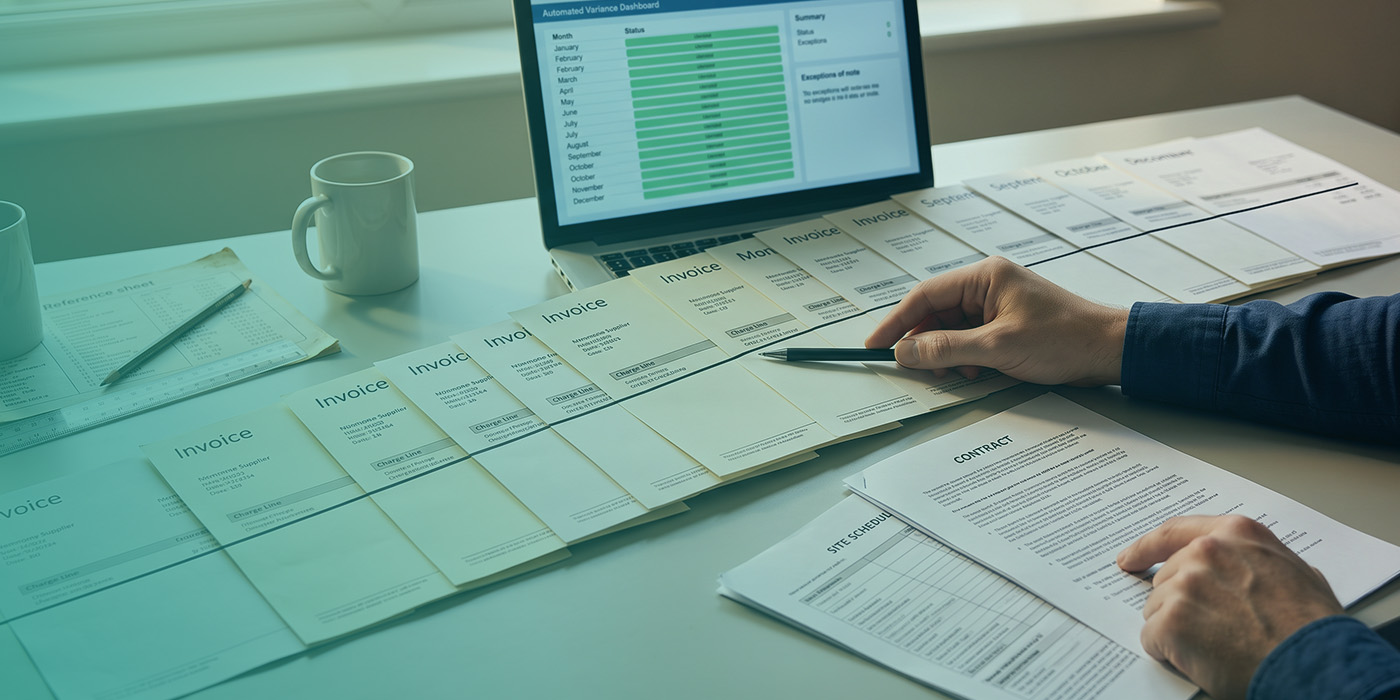
When the same billing error repeats across twelve consecutive monthly invoices, the cost is not one mistake. It is twelve. Laying the invoices out in sequence is often the first time anyone sees the pattern.
The expensive errors are the ones that never change
When people picture a billing error they picture a shock. A bill that arrives at four times the usual figure and somebody in accounts notices.
Those are not the expensive ones. Those get caught, because they look wrong.
The expensive errors look completely, perfectly normal. Take the available capacity on a half hourly supply. You are charged for the capacity your site is authorised to draw, in kVA, whether you draw it or not. If your authorised capacity was set at double what the building has ever actually needed, you pay for the difference every single month, for as long as nobody looks.
That invoice never spikes. It never varies. It arrives at the same wrong number, month after month, year after year. And it looks exactly like a correct invoice, because from the supplier’s point of view it is one.
The same is true of a meter multiplier that does not match the bill. Or a site you sold two years ago that is still quietly being billed to you because somebody at the supplier never closed the account.
None of these trip an alarm. There is no alarm to trip.
And a genuine billing error is generally recoverable for up to six years. So an error found today is not only a leak stopped. It is money back, and sometimes a great deal of it.
Why volume cannot help you here
I want to be careful, because this is not a criticism of the large national bureaus. It is arithmetic.
If you are processing a million invoices a year, you automate. You have no choice. And automation is genuinely excellent at one thing: catching the invoice that suddenly looks different from last month. Variance is what it is built to find.
But a stable, recurring error does not vary. It is the most consistent line on the bill. Automation is structurally blind to it, because consistency is precisely the thing it has been trained to trust.
What finds an error like that is a person with the contract in front of them, who knows the site well enough to read the line. That work does not scale. Which is exactly why it is worth paying somebody to do it.

This is what utilities billing validation actually looks like in a functioning team: paper in, data on screen, documents passing between desks and archive boxes holding the history that explains why this month’s invoice looks the way it does.
What that actually looks like
A couple of years ago we took on a portfolio whose relationship with their previous consultant had broken down. The invoices arrived with us in storage boxes.
Not a data feed. Not a portal. Boxes.
Getting that estate to a point where the client could tell what needed paying and what did not was a great deal of manual work, and there is no clever way to do it. Somebody opens the box. Somebody reads the invoice. Somebody digs out the contract. Somebody compares the two.
When I sat down with their main contact in January, the thing he chose to talk about was not the money. It was that we had come down and sat with different people across the business to understand how they actually operate.
Neither portfolio left over price
The other estate we won last year came from a national broker with a genuinely strong procurement team. Their feedback was blunt and it has stayed with me. The rates were good. The bureau side was not, and because they were a smaller client, they had the distinct feeling that nobody was watching their account.
So they went looking for somebody who would.
The ethos here has always been that it should not matter how big or small you are, because you get the same level of attention either way. That is an easy thing to say and an expensive thing to mean, and the only real proof of it is whether people stay. That portfolio renewed a couple of months ago without a single issue raised.
You can be on an excellent rate and still be overpaying. Those two things are not in tension. That is the normal state of affairs, and it is the single most useful thing I can tell a landlord.
Why this was the first webinar we ever ran
When my team validates an invoice, we are checking that the unit rate matches what our procurement team negotiated. With half hourly data we review the consumption too, so you are not billed for 500 kilowatt hours when you used 300. What reaches your accounts team has already been through all of that, and all they have left to do is upload it and pay it.
But the reason this matters beyond the finance function is what happens next.
That validated consumption data is the same data set your carbon report runs on. It is where an energy management programme starts, and it is where your environmental reporting starts. If your invoices are estimated, your Scope 2 is estimated, and there is no clever reporting at the far end that repairs a bad number at the near end.
It is why my team sits alongside the sustainability team rather than in a different part of the building. We are working on the same data. We just see it first.
One question
Ask who checks your energy invoices, and what they check them against.
If the answer is that the supplier’s system does it, then nobody is checking. The supplier’s system is the thing producing the invoice.
FAQ’s
What is energy bill validation?
Bill validation is the process of checking every utility invoice against the contract and the metered consumption before it is paid. It confirms that the unit rate charged matches the rate that was negotiated, that the consumption billed matches the consumption actually used, and that the network charges, levies, standing charges and capacity charges have all been applied correctly. It is a continuous monthly process rather than a one off audit.
How common are errors on commercial energy invoices?
Published figures vary widely, from around 4 per cent of invoices to more than 20 per cent, and almost all of them come from firms selling bill validation services. Very few are traceable to a primary source, so we would treat any single headline number with caution. A more useful question is why errors persist at all, and the answer is structural: commercial energy invoices are layered with technical non commodity charges that change annually, suppliers are not obliged to check that they have applied them correctly to you, and a stable recurring error looks identical to a correct charge.
What is an available capacity charge and how would I know if mine is wrong?
On a half hourly electricity supply you are charged for the capacity your site is authorised to draw, measured in kVA, whether or not you draw it. If your authorised capacity was set higher than the building has ever actually needed, you pay for the excess every month indefinitely. To check it, compare your authorised capacity against your actual maximum demand over the last twelve months of half hourly data. If there is a persistent gap, you are paying for capacity you have never used.
How far back can I reclaim an energy overcharge?
Genuine billing errors are generally recoverable for up to six years under the Limitation Act. Separately, back billing protections limit how far back a supplier can charge you for energy it failed to bill. The practical constraint is usually evidence rather than time, which is why maintaining validated invoice records matters as much as the recovery itself.
Why does my supplier not catch these errors?
Because the supplier’s system is the system producing the invoice. It has no independent view of what your contract says it should be charging you, and no obligation to audit itself on your behalf. Validation only works when it is done by somebody sitting on your side of the transaction with a copy of the contract in front of them.
Does automated invoice checking find these errors?
It finds some of them. Automation is very effective at flagging variance, which means it catches the invoice that suddenly looks different from last month. It is far weaker at finding a stable recurring error, because that error does not vary and therefore does not look anomalous. The errors that cost the most tend to be exactly this kind, arriving at the same incorrect value every month for years.
Does bill validation help with ESOS and SECR reporting?
Directly. Validated consumption data is the same data set that underpins a SECR disclosure, an ESOS assessment and a Scope 2 carbon figure. If your billing data is estimated or incorrect, your carbon reporting inherits that error, and no amount of careful work at the reporting stage repairs it. Validation is the foundation of the energy and carbon programme rather than a finance exercise sitting to one side of it.
View
View

View

View

View

View

