




 Share
Share
Energy procurement in 2026 is no longer about chasing the lowest unit rate.
For large energy users, including commercial property portfolios, multi site corporates, manufacturers, and public sector estates, the balance of risk has fundamentally shifted. Non commodity costs now dominate electricity bills, operational behaviour directly influences exposure, and procurement decisions made today lock in multi year financial outcomes.
Wholesale electricity prices still matter, but they are no longer the primary driver of cost. The organisations that succeed in 2026 will be those that manage total delivered cost, operational risk, and long term exposure using accurate data, flexible strategy, and strong governance.
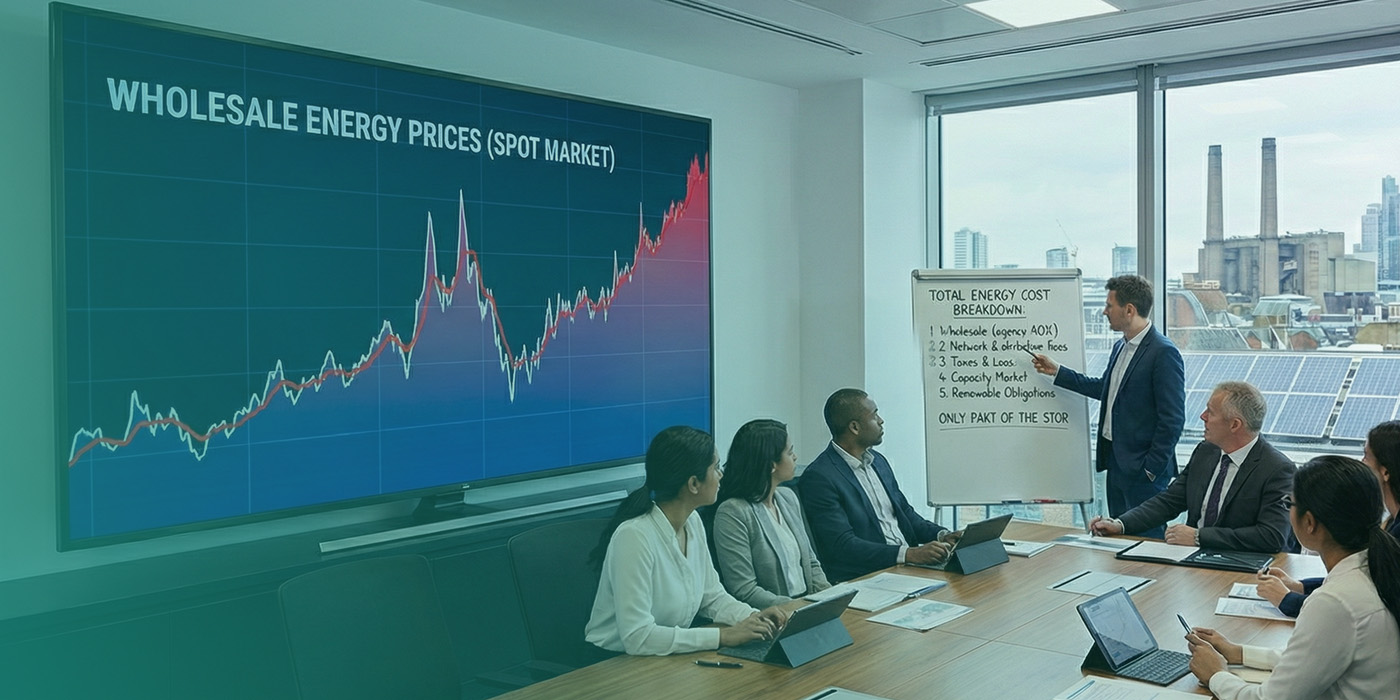
Wholesale prices still matter, but Energy procurement in 2026 for large users requires a far wider view of total cost and risk.
Wholesale Prices Still Matter, But They Are Only Part of the Story
After the volatility of 2022 and 2023, wholesale markets feel calmer. Fixed contracts are available again. Forward curves look more predictable.
This has created a false sense of security.
For many large users, wholesale energy now accounts for just 30 to 50 percent of total electricity spend. The remaining cost sits in non commodity charges, including network fees, policy levies, Capacity Market costs, balancing charges, settlement, and supplier pass throughs.
In practical terms, this means that even a well timed wholesale purchase can be undermined by poor forecasting, weak operational control, or unfavourable contract structures.
Preparation in 2026 means budgeting for total cost, not just price per kilowatt hour. It also means aligning hedging strategies with operational forecasting rather than static budget assumptions.

Non commodity costs are now the biggest risk and opportunity in Energy procurement in 2026 for large users.
Non Commodity Costs Are Now the Biggest Risk and Opportunity
Non commodity costs are rising faster than wholesale prices and are becoming more complex, volatile, and difficult to manage without insight.
Key drivers include transmission and distribution charges under RIIO 3, Capacity Market costs linked to security of supply, balancing charges driven by renewable intermittency, environmental and social levies, and the Nuclear Regulated Asset Base levy.
For large users, these charges now dominate electricity budgets.
They are also increasingly sensitive to when and how energy is consumed. Time of use, peak demand, and site behaviour now directly influence cost exposure.
The key insight for 2026 is simple. Controlling non commodity costs is now the primary lever for savings and budget certainty.

Network investment and regulation are becoming central to Energy procurement in 2026 for large users.
RIIO 3 and the Cost of Network Investment
The transition into RIIO 3 is a major driver of rising network charges.
Significant investment is required to reinforce the grid, connect renewable generation, support electrification of heat and transport, and maintain system resilience. These costs are recovered through Transmission and Distribution Use of System charges paid by end users.
For large energy users with high peak demand or poorly understood load profiles, exposure to these charges can be substantial.
Once procurement decisions are made, this exposure is difficult to unwind. This makes accurate forecasting, half hourly data analysis, and demand management essential before contracts are signed.

Nuclear investment frameworks are becoming a material consideration in Energy procurement in 2026 for large users.
Nuclear RAB Is No Longer Theoretical
The Nuclear Regulated Asset Base levy linked to new nuclear development is now embedded in electricity bills.
Many contracts allow this levy to be passed through directly, often without caps. For organisations that did not fully understand how this cost would be treated contractually, it is already appearing as unexpected budget pressure.
This is a clear example of policy driven cost risk being transferred from suppliers to customers through procurement structures.

Capacity Market and Balancing Costs are rising structural pressures within Energy procurement in 2026 for large users.
Capacity Market and Balancing Costs Continue to Rise
As the UK electricity system becomes more reliant on intermittent renewables, the cost of maintaining security of supply is increasing.
Capacity Market charges are rising as the system secures sufficient generation and flexibility. Balancing costs are increasing due to system stress and variability.
With the rollout of Market wide Half Hourly Settlement, exposure to peak demand periods will become even more granular.
Organisations that do not understand their half hourly profiles are exposing themselves to unnecessary cost volatility.

Fixed contracts do not remove risk within Energy procurement in 2026 for large users.
Fixed Contracts Do Not Guarantee Fixed Outcomes
Fixed price contracts still play an important role in managing volatility, but in 2026 they do not guarantee budget certainty.
Most fixed contracts include significant pass through elements for non commodity charges. If these costs increase, or if operational behaviour drives higher exposure, total spend rises regardless of the fixed unit rate.
We are seeing fixed contracts signed with underestimated non commodity forecasts, uncapped pass through clauses for new levies, rising Capacity Market costs, and poor alignment between contracted volumes and actual consumption.
Once agreed, these assumptions are locked in. Correcting them later is slow and expensive.
Multi Year Exposure Raises the Stakes
Many organisations are signing multi year contracts to secure stability. In doing so, they are locking in exposure to network charges, levies, Capacity Market costs, settlement structures, and supplier risk allocation for several years.
This makes forecasting accuracy, contract review, and data quality more important than ever.
Errors made today can shape cost exposure for the next three to five years.
Half Hourly Data Is Now Essential
Granular half hourly data allows organisations to understand what actually drives cost.
It reveals peak periods that influence network, Capacity Market, and balancing charges. It distinguishes base load from flexible demand. It supports smarter procurement, load shifting, and operational scheduling.
Without this insight, procurement decisions are based on averages rather than reality.
BMS Optimisation Is a Cost Control Tool
Building Management Systems play a critical role in managing demand and reducing exposure to non commodity costs.
Aligning HVAC, lighting, and plant schedules with actual occupancy reduces unnecessary consumption. Smoothing load during peak periods limits exposure to DUoS, TNUoS, and Capacity Market charges.
Even modest BMS optimisation can deliver immediate savings in 2026 because it directly targets the fastest rising elements of cost.

Flexibility is now a core requirement in Energy procurement in 2026 for large users.
Flexibility Is No Longer Optional
Energy flexibility is now a core risk management tool.
Flex allows organisations to adjust demand during specific system stress or peak periods. This reduces exposure to network charges, Capacity Market costs, and balancing charges.
It also improves forecast confidence. Predictable demand profiles reduce supplier risk and margin loading. In some cases, elements of non energy cost exposure can be stabilised or fixed annually.
Flex works best when integrated with half hourly data analysis, BMS optimisation, operational scheduling, and procurement strategy. Treated properly, it reduces volatility, improves predictability, and strengthens commercial outcomes.
Share Data Across Teams
Energy can no longer sit in a procurement silo.
Operational behaviour drives cost. Facilities, estates, sustainability, and finance teams all influence exposure.
Sharing clear, simple insight aligns behaviour with cost reduction goals. Transparent dashboards often deliver greater savings than headline price negotiations alone.
Energy Procurement Is Now Risk Management
In 2026, energy procurement is as much about risk management as cost.
Regulatory change, network reform, new levies, and evolving settlement structures all require active oversight. Supplier contracts must be scrutinised for pass through risk and escalation mechanisms.
Energy should be treated as a managed risk portfolio, not a commodity purchase.

Have more questions about Energy procurement in 2026 for large users? Start the conversation.
Why Inteb’s Role Is Different
At Inteb, energy procurement is not treated as a transactional buying exercise.
Our role is to protect clients from long term structural exposure, particularly the non commodity and forecast risks that now dominate bills.
We focus on total delivered cost, integrate Flex into procurement strategy, stress test forecasts against regulatory and network change, challenge supplier assumptions, and align procurement with real operational behaviour.
We also support ongoing energy and Flex management after contracts are signed, ensuring cost and risk remain controlled year on year.
In an environment where non commodity costs are rising fastest and forecast risk directly drives supplier margin, advisory led procurement is no longer optional.
In 2026, it is essential.
View

View
View

View

View

View

